Okay, Pull Up A Chair, Let’s Talk About the ID Lie We All Tell Ourselves
I’m gonna be honest with you. I have been in the trenchless business for five years now and if there is one question that has made me want to hit my head against a mud tank more times than I can count it is the whole bigger inner diameter equals more flow fairy tale.
First year on the job? I was that arrogant salesman. Fresh out of product training, spreadsheet in one hand, coffee in the other, thinking I had it all figured out. Larger ID, larger cross section, larger flow.. simple math isn’t it? I even printed out a little cheat sheet with area calculations, and taped it to my monitor. I felt like a genius.
Then I got the phone call.
A guy in Texas, Rick (because that’s his real name and he’s probably reading this somewhere), called me up and his first words were, and I quote, “Son, did you guys make these drill rods out of drinking straws?
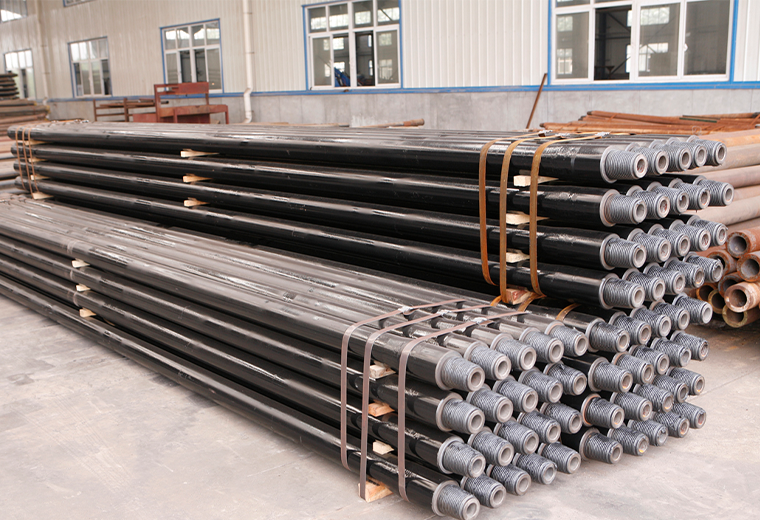
He had just purchased a bunch of our 3.5” OD rods with what we both thought was a “generous” 2.5” ID. He was pumping the same pump, same mud, same everything. But his pressure was spiking, his flow out the bottom was pathetic, and he was getting less fluid through the bit than he did with his old, skinnier 2.25” I.D. rods. He said, point blank, “Your pipe is choking my rig, and I’m about to put it on a trailer and send it back to you COD.”
Ouch. It was a direct hit to my sales ego.
First thought I have? Safeguard the product. It is the pump. Blame the turrets. Blame the moon. But something didn’t feel right. The numbers on paper were perfect. So I did the most sensible thing, booked a flight to Texas, got myself a hard hat and went to see the disaster for myself.
The Paper Math: Why “Bigger” Always Looks So Sexy on a Spec Sheet:
Let’s be honest with one another. The bigger the number on the datasheet for Inner Diameter the happier your brain does a dance. Mine certainly did.
You pull up your phone, type in the formula for area of a circle (πr², remember that from high school?), and boom, you learn that a 2.5” ID gives you about 23% more cross sectional area than a 2.25” ID. 23%!” That is huge! You start dreaming about faster penetration rates and less pump wear, and your boss patting you on the back for being such a smart buyer.
I’m not gonna lie – I sold that dream. I could wave the spec sheet in front of the customers and say, “Look at this ID! Your mud’s gonna flow like a river through this thing! And they would sign the PO. And nod. Eyes wide.
But here’s the dirty secret nobody tells you in training class: we’re not pumping water through a smooth, clean glass tube. We are pumping a mean, chemical-laden, sand-filled mud smoothie that has a personality disorder. And that stuff doesn’t act like the clean water of your high school physics experiments.
The Field Smackdown: When Your Drill Pipe Becomes a Sediment Trap
So there I was, standing besides Rick on his rig in the middle of nowhere Texas, staring at his pressure gauges as if they were going to confess to a crime.
We did some testing. The fluid was just… lollygagging through that big, beautiful 2.5” hole at his normal pump rate. The pipe was bigger so the velocity was way down. And you know what happens when the fluid moves too slow inside a horizontal drill string?
The cuttings – all that heavy sand and clay grit we’re supposed to get out – they started settling. They settled out of suspension and built up on the bottom of the pipe, particularly in the low spots of the bore path. In a couple hours that glorious 2.5” ID had effectively shrunk to about 2.1” because of all the muck sitting on the floor of the pipe.
We paid for a big pipe and we got a clogged one. I swear I could hear the pipe laughing at us. Rick looked at me with that ‘I told you so’ face.
That was my first “aha – wait, actually oh no” moment. The effective flow area is not the number on the drawing. It’s the number you get when you factor in your mud properties and your annular velocity and the fact that Mother Nature is actively trying to screw you over.
Just Crank the Pump! – Yep, That’s a Snare
So Rick and I being the brilliant problem solvers that we are said, “Screw it – Let’s bump the pump pressure and shove that mud through faster.”
Bad choice. Like, really bad.
The pressure needle on the gauge rocketed up. The pressure in the annulus was pounding the roof, the ground was shaking and I could hear the groaning of the hoses. Basically we are trying to push the volume of a firehose through a gardenhose restriction and the whole system was fighting back.
You see when you crank the flow to get the velocity back up you create huge back pressure. That energy isn’t going to clean the hole or hammer the bit. It’s going to friction. The fluid rubs on the pipe walls, heats up, degrades the polymer and turns your drill string into an expensive mud heater. We weren’t drilling, we were making soup.
The absolute worst part? It was high enough that we started to lose circulation into the formation. We were pushing mud into the ground instead of down the hole. That’s when I knew – we’d missed the sweet spot completely.
That day I had my real epiphany: ID doesn’t determine how much you can hold; it determines how well you can move it. It’s about speed, not size. “It’s about keeping the cuttings in suspension, not just putting more fluid in.”
So How Do You Actually Determine the “Real” Flow?
After that Texas mess, I stopped selling just on ID numbers. Now when a customer asks me about flow capacity I don’t pull out the spec sheet. I come up with three questions – and I ask them in exactly this order:
Question #1 Where does your pump happily live?
Not its max pressure, not its max flow, but the combination of pressure and volume where it runs all day without overheating or shaking itself to death. Because if your pump is only comfortable pumping 300 gallons per minute, putting it on a 2.5” ID rod might drop the velocity below the critical threshold and you’ll get settling. Find the sweet spot of your pump, not the biggest number you can find.
Question #2: What are you drilling through?
Clay ? Rock? Pebble? Sand? Each formation requires a different speed to move the cuttings out of the hole. Sticky clay needs to be “peeled” off the walls with high velocity. Heavy sand needs to move fast enough to keep the particles from dropping out. If you don’t understand your formation you don’t understand your required velocity – and without that the ID number is meaningless.
Question #3: What is your mud weight and viscosity?
Thicker mud can carry more cuttings at lower velocities but also produces more friction. Light mud needs more velocity but less pump strain. It’s a compromise. The ID that “works” is the one that works with your mud programme, not against it.
This is what I call the “Goldilocks approach” – not too big, not too small, but just right for your particular rig, pump and ground.
Bottom Line (and a Free Piece of Hard-Earned Advice)
These days, when a customer calls me up and says, “Hey, I want your biggest ID rod,” I put my hand on their metaphorical shoulder and say, “Hold on, partner. “First, let’s talk about your pump.”
Because here’s the truth that it took a blown pump, a pissed off Texan and a three-day field trip for me to learn: A bigger ID is only better if you can keep the fluid moving fast enough to do its job. If you can’t, you’re just buying a more expensive pipe that will fill up with cuttings, spike your pressure, and make you curse the day you ever picked up the phone.
Rick and I finally fixed that job, though not by changing pipe, but by adjusting the mud recipe (added some polymer to improve viscosity and carrying capacity) and turning the pump speed down to that sweet spot. We didn’t need a new pipe. We had to find out about how the pipe and the fluid interacted.
So next time you’re spec’ing out drill rods, don’t just drool over the ID. Ask yourself, “Can my pump push fast enough to do this? Will my mud take the load? And do I want a clogged pipe or a smooth ride?
Because I’ve been that guy. The guy who learned the hard way that math on paper doesn’t always match the mud on the ground. Save yourself the hassle. Match the ID to your entire system, not just your ego.
Alright, that’s my fury. Your turn, who else has a “bigger ID bit me in the butt” story? Leave it in the comments Coffee and sympathy are available.
Keep boring smart
By Frank
HDD Engineering Sales
RICHDRILL EQUIPMENT CO.,LTD
Share :
Recently Released
- Richdrill HDD What Products Do They Make? A No-Nonsense Guide from a Guy Who Sells Them
- How Many HDD Drill Rods in a 20ft or 40ft Container? An Honest Answer from a Factory Guy
- How to Detect Fake HDD Drill Rods Before They Fail Downhole
- How Stabilizers and Reamers Add Stress to Your HDD Drill Rods (And What You Can Do)
- When to Scrap Your HDD Drill Rods: OD Wear, Wall Thinning and Ovality Limits