Hello drillers and pipe pullers.
Let me tell you a short story. When I first started selling HDD tooling a few years ago I thought I had all the answers. One customer asked me “What is the surface material of your drill rods?”
And I came up with this super professional bullet pointed answer from the factory manual. It’s alloy steel that has been quenched and tempered, and phosphated for corrosion resistance.”
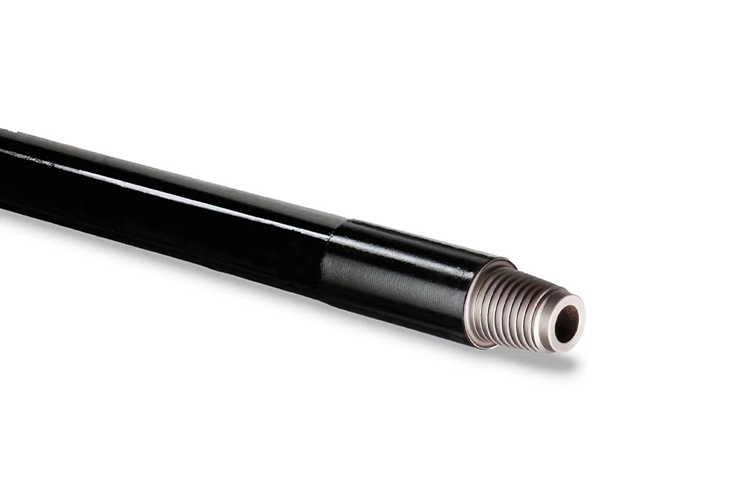
The guy just blinked at me. Then he said, “So… grey?”
I laughed. But I was dying on the inside. And in that moment, I knew one thing, nobody wants a textbook. They want the truth, in plain language. And they want to know if that “surface” is going to save their butt or leave them with a broken rod in the middle of a bore under a four lane highway.
So let’s grab a coffee (or a Monster, I don’t judge) and talk about what’s really on the outside of your HDD drill rods.
The short and honest answer: It’s just steel, but not any steel.
Here’s the deal. No fancy icing. Forget diamond layers or whatever hype you see on some websites. A good HDD drill rod has a real surface of the steel itself. Specifically, seamless alloy steel, usually grade 4140 or 4130.
What those numbers? They’ve got the right mix of carbon, chromium and molybdenum to take a beating. That steel is the surface you see and touch, after it’s been heat treated. No pintura. No plastic. No shiny chrome.
I recall a customer asking me if we could make rods with a shiny polished finish. I said, “Yes, of course, we can. But go through a sandy gravel once and it’ll look like a cat scratched it. “Plus, you’re paying for appearances that last about ten minutes.” He quickly shot the idea down.
So the ground base stuff? Alloy steel. Period .
That Dark, Matte Finish – What’s the Matter?
Right, but you’ve seen most HDD rods aren’t just bare shiny metal. They are a dark grey, nearly blackish colour. That’s not a paint job, It is normally a phosphate coating or black oxide finish.
Let me lay it out for you like I’m talking to my buddy on a jobsite.
Phosphate Coating Imagine a fine coating on the steel, that’s slightly rough. It absorbs some oil or rust inhibitor. That does not make the rod stronger. It provides some short term protection against rust as the rod sits on your truck or in the rack.
Black oxide: same idea, just smoother. Looks a little cleaner. Not armour yet.
Here’s the “aha” moment I experienced after watching a crew drill through wet clay for eight hours. That coat will come off. Especially at the tool joints and the point where the rod touches the ground. And you’re right. That’s perfectly fine. Because the coating was never the star. The hero is the steel beneath.
I remember one customer who called me in a panic. “Hey the black stuff is peeling off my brand new rods! “Are they busted?” “Did you run them in abrasive sand?” I asked him. Yes,’ he said. I said, “Then you just wiped off the temporary make-up. The rod itself is still good . “Don’t worry about it. Drill on.
But don’t fall in love with the dark finish. It helps, like the wax on your car, but it is not the metal.
The Real Magic Is Under the Surface (Heat Treatment)
Now this is the part that took me a couple years in this industry to fully understand. The question of the “surface material” is really the wrong question. The right question is how hard is the surface versus the inside?
Good HDD rods are heat treated by a process called “quenching and tempering.” But the key is induction heat treatment on the tool joint area or sometimes full body hardening. What this does is to create a hard outer layer (the surface) while keeping the inside of the steel softer and tougher.
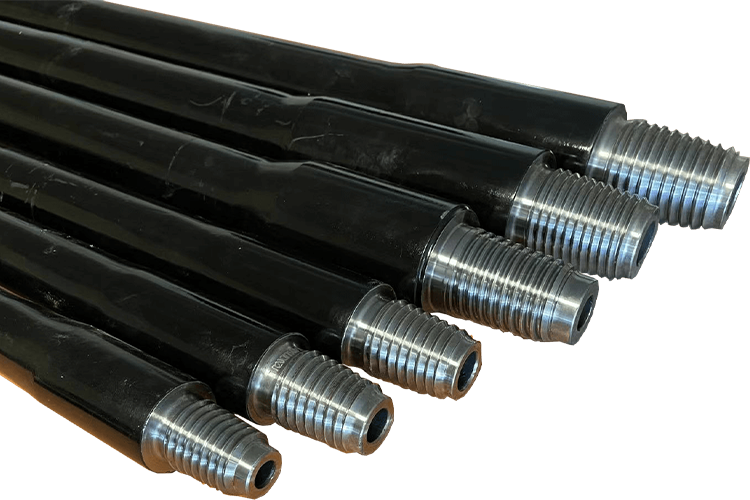
Let me paint you a mental picture. Think about those gummy candies that have a hard candy shell. The shell is hard so it doesn’t get flattened. It bends and does not break because the inside is soft and chewy. A drill rod is kind of like that, but backwards. Outside is hard to resist wear of sand, rock and friction. The inside is tough and flexible, to absorb bending and torque.
There is no hard surface layer . The rod would be worn down like a pencil ‘s eraser . “It’d snap like a glass rod without the tough inside. It’s that combo — hard outside, tough inside — that keeps you pulling pipe instead of fishing for broken pieces.
I learned it the hard way. I sold a lot of cheap rods early on from a factory that cut corners on heat treatment. The surface seemed O.K. Same dark finish. But three weeks later I got a picture from a customer of a rod that had twisted into a spiral. The surface hadn’t broken—the rod had failed completely because the interior wasn’t strong enough. I was feeling very sick. Nevermore.
So when you ask about “surface material,” what you really want to know is: did they do the heat treatment properly?
And what about coatings like zinc or ceramic?
Sometimes you’ll see sales guys pushing “zinc plating” or “ceramic infused” finishes. The thing is.
Zinc plated: Nice look. But an HDD spindle? It’s gentle. It doesn’t last long. And it can actually cause hydrogen embrittlement if not done perfectly. The majority of serious drillers do not want it.
Ceramic coatings: Sounds cool. But ceramics are fragile. A ceramic coating will chip and flake when your rod flexes and strikes the borehole wall. Then you’ve got hard particles suspended in your mud. You know what? Those particles are like sandpaper on your rods. That’s not a good idea.
There’s a reason almost nobody in the hdd world uses those. We stick with phosphate or black oxide because they’re cheap, they work well enough and they don’t cause any drama. Don’t let someone sell you some glitter.
The “Ah-Ha” Moment That Changed the Way I Talk About Surfaces
I want to tell you one last little story. I was on a site about 2 years ago with a crew drilling through shale and cobble. They had a rod that had been so well used that the whole dark coat was gone. Some places were just shiny bare metal. The foreman pointed at it. ‘This rod’s junk, ain’t it? “Surface is dead.”
I walked over, looked at the wear pattern. Tool joint was not undercut. No fractures. “Give me your hard hat,” I said. I tapped on the rod. It sounded clear. Then I said, “The phosphate is gone, yes, But the heat treated layer underneath is still there. This rod has another hundred hours in it easy. “Just look for the wear.”
He lacked faith in me. But he operated it. Six months later he texted me, ‘You were right. That rod finally gave in yesterday. Got four hundred feet more out of it.”
That’s the reality. Don’t judge a rod by its colour. Judge it by the quality of its making below.
What should you actually look for then?
Here’s my no-BS checklist for you, based on selling and learning over the past five years:
Enquire about the steel grade. Good ones are 4140 or 4130. If they don’t know, walk away.
Check on heat treatment. More specifically induction hardening on the tool joints. Full body hardening is even better on abrasive ground.
Don’t do a heavy coating. Black oxide or phosphate is good. If it wears off, that’s fine.
Look for uniform surface finish. No deep pits, no rust spots out of the box. That’s a sign of good quality control in the factory.
Forget about magic coating. If it sounds too good to be true it likely isn’t. “You’re drilling in dirt, not showing off at a car show.
And one more thing, even the best surface won’t save you from poor drilling practices. Any rod will fail from over-torquing, running dry or ignoring worn-out tool joints. I have seen $10,000 worth of rods ruined in a week by a rookie who never learned to slow down and keep enough mud flow to get through the rock. The surface held. The operator did. (Sorry, but it’s true.
Final Word – From One Dirt-Slinger To The Other
“Listen, I make my living selling drill rods. I could invent a lot of fancy words just to impress you. But that’s not how I roll. The surface of a good HDD rod is just honest heat treated alloy steel with a thin rust preventative coat. Nothing less, nothing more.
When someone tries to sell you a “revolutionary nano surface coating” next time, just smile and ask them: “Does it actually make the rod last longer, or does it just make your brochure look prettier?” Then watch ‘em stutter.
You’ve got bores to finish, pipe to pull and a crew waiting on you. Don’t waste time worrying about a drill-rod’s make-up. Worry about the steel beneath.
Be safe out there, and if you ever want to geek out on heat treatment, or share your own horror story of a broken rod, you know where to find me.
Keep boring smart
By Frank
HDD Engineering Sales
RICHDRILL EQUIPMENT CO.,LTD
Share :
Recently Released
- Richdrill HDD What Products Do They Make? A No-Nonsense Guide from a Guy Who Sells Them
- How Many HDD Drill Rods in a 20ft or 40ft Container? An Honest Answer from a Factory Guy
- How to Detect Fake HDD Drill Rods Before They Fail Downhole
- How Stabilizers and Reamers Add Stress to Your HDD Drill Rods (And What You Can Do)
- When to Scrap Your HDD Drill Rods: OD Wear, Wall Thinning and Ovality Limits