I just walked in from the shop, I’ve still got a little bit of bentonite on my boots and I wanted to talk about something that I’ve been thinking about (and you probably have too) every single time we fire up the rig.
For the last five years I’ve been knee deep in the non stop, dirt-under-the-nails world of HDD, living and selling these drill rods day in and day out. And there’s nothing I’d rather do than bash my head against a rack of pipes than watch a perfectly good set of rods go to hell before their time.
Not from a big failure or a horror show down hole, but just from… neglect. Little things The stuff we all know we should do but don’t because we’re tired, it’s raining or the foreman is breathing down our necks.
So I’ll share some of the things I’ve learned. Not from a manual – those put me to sleep – but from my own dumb mistakes and some “aha!” moments that saved my bacon.
The Cleanliness Is Next to Godliness Myth (And Why It’s Right)
Let’s get that out of the way. You have heard it a million times: Keep your rods clean . Yeah, yeah. But I’ve got a story for you.
I had a customer, oh, about three years ago, great guy, runs a tight crew. But they were in a rush on a river crossing and would leave the rods spread out on the ground between shots. You know, for a couple of hours. No caps. No stands. Just having a nice sticky mud bath.
Within three weeks they were having trouble with thread galling. You know that awful screech when you’re rolling up a joint and it just feels… gritty? They figured it was a bad batch of steel. They sent the rods back to us, and I had to break the bad news. Under the microscope, those threads looked as if they had been sandblasted. The dirt had got down in the zinc coating and then when they made up the joint it was like lapping compound. They essentially destroy their own threads.
My rule, and I stand by it is: your rods should be cleaner than your dinner plates. I’m not joking. I don’t care if you have to use a wire brush and a prayer, but get the grit off the threads and the tapered shoulders before you even think about stabbing them into the box end. That gunk is not just dirt, it’s a microscopic excavator slowly eating away at your connection.
I always keep a couple of cheap PVC end caps in my truck. It’s a $2 fix that saves you a $200 repair. Get them off the ground, put caps on the ends, treat the threads as though they were glass. Let’s face it, in the grand scheme of things, it’s the threads that are holding that drill string together. When they go, you’re not just replacing a rod, you’re fishing for an expensive disaster.
The “One and Done” Lubrication Myth
Oh man. This one makes me angry.
I can’t count how many times I’ve seen a guy just slop a bunch of thread compound on the pin, stick it in and say he’s done. Then they run the rod 500 feet and pull it back, and there’s no compound left. Scraped away and washed away by the mud.
You need to think of thread compound like sunscreen. If you put it on in the morning and go swimming all day, you’re going to get burned. You have to apply again.
I learned that the hard way. I was on a job site watching the tool pusher just hammering the rods together. “How often do you lube?” I asked him. He looked at me like I had two heads and said, “Every time I make it up. But he wasn’t using it every time he stabbed a link in. He was just doing it on the first stab from off the ground.
The problem? “ Break a joint and all the mud fines pollute the compound. It’s not doing what it’s supposed to do anymore. It’s just squishy mud. So my ritual is: break the joint, clean the pin, put the compound back on. It requires 20 seconds.
Twenty seconds to keep your threads from heat-checking and galling. “I’ve had rods that have done over 20,000 feet of bore because we treated every single makeup like it was the most important one.” It’s boring work but it’s the work that counts.
Torque: Not a “Feel” Thing
This may sound like stating the obvious, but you’d be surprised how many people guess the torque.“Yeah, that sounds good enough.”
Be quiet. Now. Just halt.
I hear you. It used to be the “grunt” and swing of the pipe wrench. But we don’t use wooden telephone poles anymore. Very specific heat-treated alloys. Very high strength. Very specific comfort zone.
Too little torque and the connection rattles itself loose under vibration. That’s how you get washed out pins and popped joints. Too much torque and you are stretching the threads or bulging the box end. And that’s how you get cracks you can’t see just waiting to snap under load.
I remember a client that broke three rods in one month. I just snapped them right off in the bore. We tested the quality of the steel. Perfect. We checked the heat treat. It was perfect. “We finally fitted a digital torque gauge to his rig and he was over-torquing by almost 35% because he “liked the sound it made”. It was the sound of his wallet crying.
Trust your torque wrench. If you don’t have one of those gauges that tells you the real foot pounds, put a mark on your tongs at the proper pressure and stay with it. Checking the gauge is a sign of intelligence, not weakness. Your rods come back up in one piece, and that’s your insurance policy.
Storage: Treat ’Em Like Fine Wine (Or At Least Like Not-Garbage)
We all get in a hurry to get packed up and go home. The sun is going down, the mosquitoes are biting, you just want to get to the truck stop for a burger. So you pile the rods up in a mess or lean them against the trailer.
Look, steel is a lazy. It wants to curve. If you store your drill rods bowed, or leaning at some angle for weeks on end, they will “set”. They are not straight anymore. And if you run a bowed rod through a straightener and into your bore you create eccentric wear. That means you are wearing out the rod surface unevenly which leads to thin spots and eventually a fish.
I spent a Saturday—a Saturday, people—helping some guy sort out a pile of rods that had been stacked up like firewood over the winter. “We had to throw away almost 15 percent of them because they were bent too much. It was a $10,000 lesson he learned about the importance of a proper pipe rack.
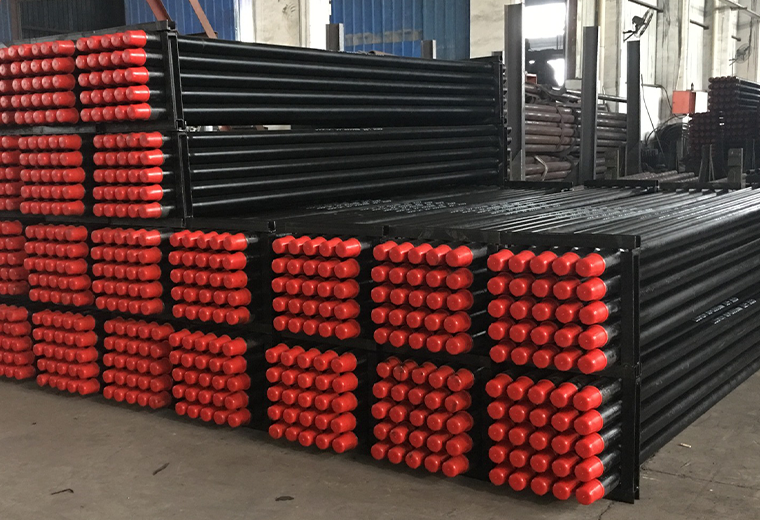
My counsel. Build or buy a rack that supports the rods along their length. Cradles are preferable. And if you don’t have dividers don’t stack them higher then three. And for Pete’s sake, if you live in a place with real seasons, cap those suckers and give them a coat of light oil if they’re going to sit for more than a month. The enemy is rust. Rust is the slow and creeping death of your investment.
The “Visual Walk-Around” Saves the Bacon
Every morning, as I wait for my coffee to kick in, I have a little ritual. I walk around the row of rods.
I don’t want the big cracks. They’re easy to see. I’m looking for the “tells”. I’m looking for spiral wear marks that are too deep. I’m looking for the slight discoloration near the threads that indicates too much heat. I’m looking for that little dimple in the tube body that says, “Hey I hit a rock and I have a stress riser now.
This is what your drill reports won’t tell you. It’s the sort of thing you only see with your eyeballs. I had a guy tell me once he didn’t have time for that. “You don’t have time not to,” I said. “5 minutes walking and looking could save you a 5 hour fishing job.”
It’s like looking at the oil in your truck. You don’t really want to do it, but you feel like an idiot when the engine seizes on the highway. Same thing with these rods. Look at them.
So, What’s the Verdict?
Look, I make a living selling these things. You need to get more poles. But I want you to buy more rods because you are growing your business and taking on bigger jobs, not because you are replacing worn out junk that should have lasted twice as long.
These rods are the mules of the construction world.” They work hard, They carry heavy loads, They take a beating. “But you’ve got to feed them and water them. Wash them, Grease ‘em. Torque them correctly. Don’t pile them up like junk. Just… look at them once in a while.
It’s simple as hell. It’s just doing the mundane things that nobody wants to do so you can do the fun things, the mundane, the crossings, the big pulls, without the heavy headache of a downhole failure.
Now, if you’ll excuse me, I’ve got to go and wash the mud off my boots. And my drill rods, maybe.
Keep boring smart
By Frank
HDD Engineering Sales
RICHDRILL EQUIPMENT CO.,LTD
Share :
Recently Released
- How to Detect Fake HDD Drill Rods Before They Fail Downhole
- How Stabilizers and Reamers Add Stress to Your HDD Drill Rods (And What You Can Do)
- When to Scrap Your HDD Drill Rods: OD Wear, Wall Thinning and Ovality Limits
- The #1 Mistake New HDD Operators Make With Drill Pipe (And How To Fix It Right Now)
- HDD Projects for River Crossings: How to Select Drill Rods That Won’t Buckle