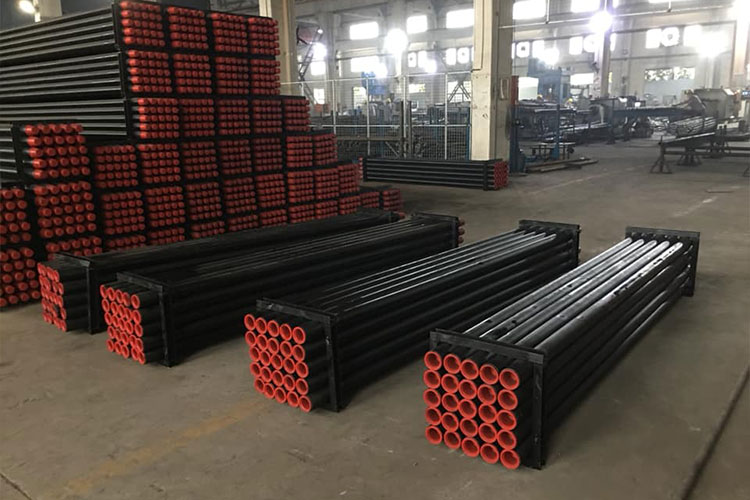
A freight quote asks for the weight of a drill pipe shipment. The purchase order says “30 rods,” the supplier’s sheet gives two weights, and the yard has added a steel frame. Which number belongs on the booking? First establish what one rod means on this order. Then keep the weight of the saleable parts separate from everything that travels with them.
How do you calculate HDD drill pipe weight?
For one pipe part number, multiply the quantity by its published or supplier-confirmed weight per piece. For a mixed shipment, do that calculation separately for each part number and add the subtotals. That gives an estimated net product weight. Add the weight of the actual frames, spacers, protectors and other packing items to estimate the packed gross weight. Before dispatch, record the measured packed weight when it is available.
The most consequential error can occur before the multiplication. A conventional rod might appear as one line item per working length. A mechanical dual-rod system can list an inner member and an outer member separately. A figure labelled “outer rod weight” covers only that component. If the crew ordered complete working sections, the inners travel too. Conversely, an order to replace worn outers may be exactly that: an outer-only shipment. Read the item description before assuming either case.
A 30-section example using published rod weights
The dual-pipe table in the Vermeer D23x30DR S3 specification sheet lists a 27 lb inner rod and a 75 lb outer rod for the configuration shown. Together they account for 102 lb of listed component weight per complete section. These are figures for that particular configuration. Use the offered part numbers and the supplier’s current data for an actual order.
| Hypothetical order | Outer members | Inner members | Estimated net weight |
|---|---|---|---|
| 30 outer replacements | 30 × 75 lb | None | 2,250 lb |
| 30 complete sections | 30 × 75 lb | 30 × 27 lb | 3,060 lb |
| 30 complete sections plus two spare inners | 30 × 75 lb | 32 × 27 lb | 3,114 lb |
Leaving the inner members off the second order understates the product weight by 810 lb. Counting the two spare inners in the third order as two additional complete sections makes the opposite mistake: it invents two outers weighing 150 lb together. On a packing list, “30 sets plus two inner spares” gives receiving enough detail to distinguish all three orders.
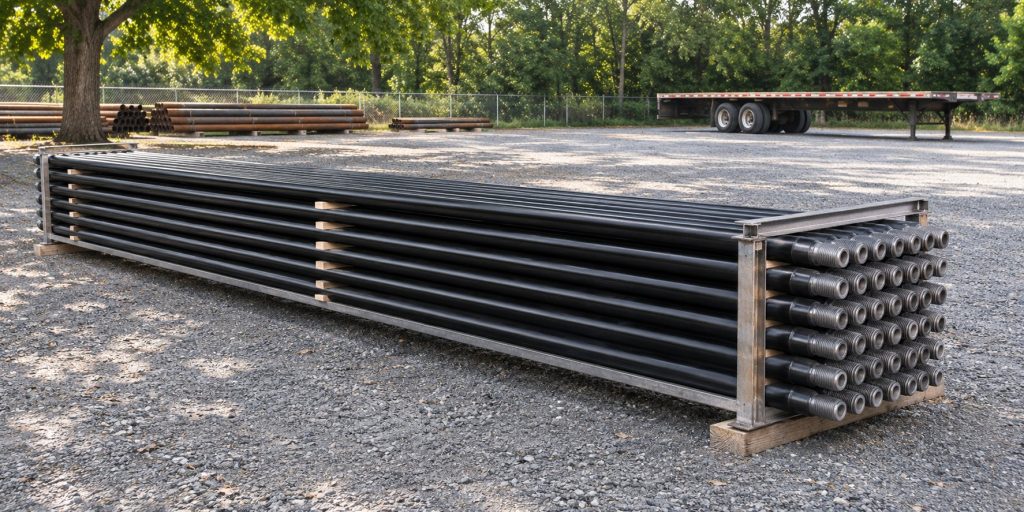
What changes when the rods go into a frame?
Assume the third order ships as one package and all its packing materials together weigh 186 lb. That figure is an illustrative allowance. The estimated gross is 3,114 + 186 = 3,300 lb. If the two spare inners travel in a separate crate, rebuild the calculation by package. Each frame or crate gets its own tare, contents, gross weight and external dimensions. The combined net product weight stays the same, but the combined gross can change.
An old packing list can help identify the frame style. Its tare may no longer apply if a yard has replaced timber, changed the frame or added end protection. Weigh the empty assembly when practical or obtain its documented tare. Note which packing pieces that number includes. Otherwise one person may include the timber in the frame weight and another may add the same timber again under “packing.”
Why a weight-per-foot figure can mislead
For the ten-foot section in this example, dividing 102 lb by ten gives 10.2 lb per listed foot for the complete pair. That ratio is useful for checking the arithmetic on repeated sections of the same configuration. It is a poor substitute for a per-piece figure on a mixed order. The end connections, inner drive interface and pipe body all contribute to the published weight. Multiplying a generic tube weight by nominal length can leave parts of the assembly out.
Preserve the original units until the final subtotal. A sheet that prints rounded metric and imperial figures can produce slightly different totals if one employee multiplies the rounded kilograms and another converts the total pounds. Mark estimates with their units and source. When the carrier asks for the measured weight in kilograms, use the measured shipment value and keep the earlier estimate for reconciliation.
What should the supplier put on the packing list?
Request a line for each part number showing quantity, unit weight, unit of measure and subtotal. For each physical package, request a package ID, the parts packed inside, net weight, tare, gross weight and outside dimensions. On a split delivery, the package ID connects the paperwork to the steel that actually reached the yard. If a spare item ships later, revise the affected package total instead of copying the original order total onto both deliveries.
When asking about the Richdrill HDD drill pipe range, include whether the requested figure is per rod, per matched section or per packed bundle. For a quote covering a dual system, the single-rod and dual-rod ordering guide explains how to specify which members the order includes. For handling or transport planning, give the responsible contractor the actual package dimensions and verified gross weight for each package.
Reconcile a difference before signing off
If the scale shows 3,360 lb against an estimate of 3,300 lb, start by confirming that the ticket belongs to the same package ID and uses the same units. Then compare the loaded quantities, packing record and documented tare. A 60 lb difference alone cannot identify a missing or extra rod. Changing the piece count just to make the arithmetic balance can turn a packing discrepancy into an inventory error.
Keep the final note short enough to travel with the shipment: “30 outer members, 32 inner members, estimated net 3,114 lb; gross and dimensions per attached package tickets.” That preserves the buying decision, gives the carrier the relevant measurements and leaves the receiving crew a count it can verify independently.