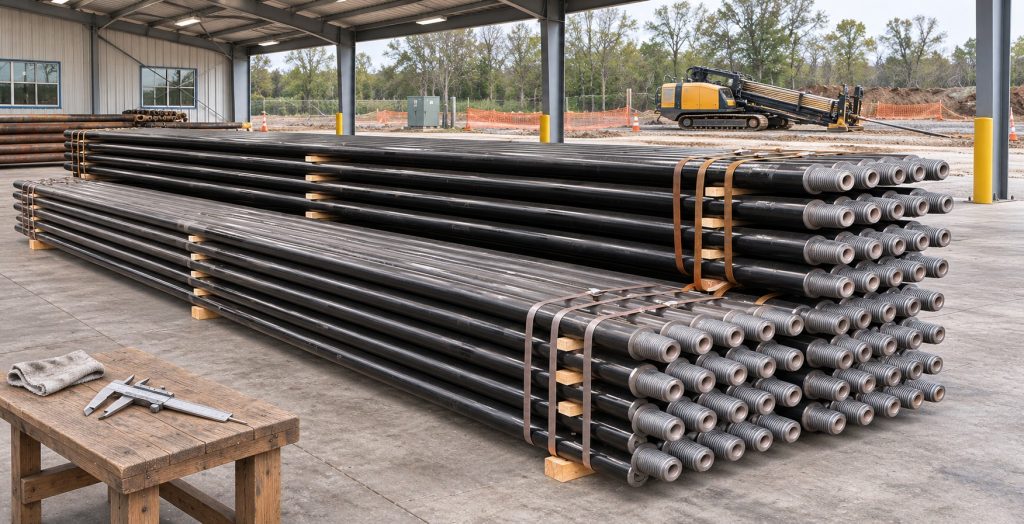
A buyer asks for a reamer for two 4-inch conduits. The tooling supplier needs one more dimension before that description is useful: how large is the pack that will actually pass through the bore? Two conduits can carry the same trade size while their actual outside diameters differ. Put them side by side and a small error in the diameter appears twice in the pack width.
What size HDD reamer do two conduits need?
Start with the outside envelope of the assembled product. For two identical round conduits touching side by side, the smallest circle enclosing the pair has a diameter equal to twice one conduit’s actual outside diameter. If each conduit measures 100 mm OD, the pair spans 200 mm. This is a measurement of the product pack. Clearance for the installation is a separate design decision.
Vermeer’s reamer selection guide uses 1.5 times the widest product pack as a starting recommendation. Applied to the 200 mm example, that gives 300 mm for a preliminary tooling discussion. The project specification, ground conditions, available fluid system, rig and planned stages still need review. A supplier who receives only the result of the multiplication cannot check what went into it.
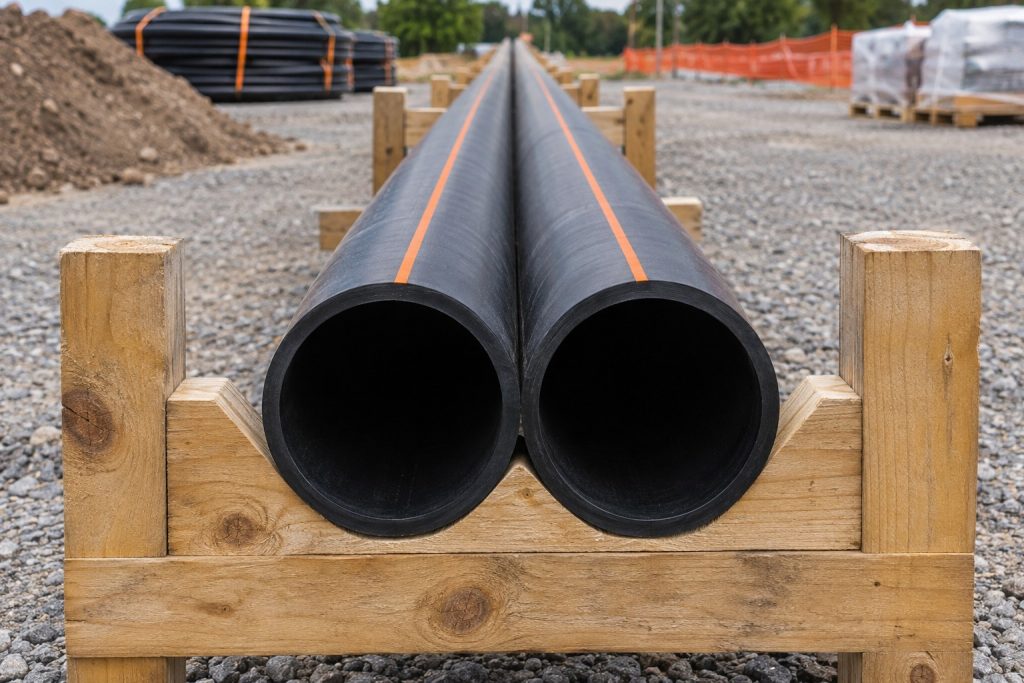
Three measurements that look similar on a purchase request
| Dimension | Example | What it tells the buyer |
|---|---|---|
| Outside diameter of one conduit | 100 mm | The space occupied by one round product at that section. |
| Envelope of two touching conduits | 200 mm | The smallest circular opening that can contain this ideal cross-section, before installation clearance. |
| Preliminary reamer diameter using a 1.5 factor | 300 mm | A candidate diameter to check against the design and tooling constraints. |
The radius of that hypothetical opening is 150 mm. Subtract the 100 mm radius of the enclosing product circle and the theoretical radial difference is 50 mm. Calling the full 100 mm difference in diameters “100 mm of clearance on each side” doubles the allowance on paper. Actual clearance varies around a bundle and along a bore. Ground response and product position can change it further.
Why adding conduit areas can understate the required opening
Suppose an estimator adds the areas of two 100 mm circles and asks what single circle has the same area. The answer is about 141 mm in diameter. That calculation has a legitimate meaning: it describes an equal-area circle. Try to place the two original circles inside it, however, and their outer edges remain 200 mm apart. The plastic conduits cannot occupy that equal-area circle while retaining their round shapes.
A simple cross-section sketch exposes this mistake. Draw each conduit to the same scale and show which surfaces touch. Outline the circle needed to contain the complete arrangement. If the pack includes spacers or an external element that changes the envelope, add it in its actual position. With a more complicated arrangement, a single width measured across a convenient face can miss a longer diagonal. Request the circumscribed dimension from the designer or the approved bundle drawing.
Measure the pull assembly as well as the straight product
A photograph of the straight pack answers one question. A drawing of the leading assembly answers another. The pull head and its connections can present a different cross-section from the conduits behind them. Send the reviewer the maximum external dimensions of both sections, identified separately. This allows the designer to check each component’s passage and avoids quietly substituting a single-pipe outside diameter for an assembly dimension.
For example, a worksheet may state “two conduits, 200 mm combined,” while a revised drawing adds a spacer between them. If the clear gap is 12 mm and both conduits remain 100 mm OD on the same line, their total span becomes 212 mm before accounting for any spacer projection. An old sketch with a 200 mm label now describes a different pack. Record the drawing revision beside the measured envelope so purchasing can trace a change in the requested reamer.
Choose the cutting tool after the diameter is understood
Equal outside diameters do not make two reamers equivalent. Ground description, cutting structure, connection and the drill’s available capacity all affect the tooling discussion. Include evidence of changing ground along the crossing and identify whether the tool is for an intermediate pass or the final enlargement. When asking about Richdrill reamers and hole openers, include the machine and the connection actually fitted to the string. A quote for the right diameter with the wrong connection leaves an interface unresolved at dispatch.
Ask which dimension the supplier guarantees: nominal tool size, new cutting diameter or a measurement of a used tool offered from stock. On a tool with replaceable cutting components, identify the configuration represented by the quoted diameter. A yard inventory description can survive several changes of cutting parts. The buyer needs the configuration that will arrive for this job.
A request for quotation that keeps the assumptions visible
A useful request might read: “Two round conduits, each 100 mm actual OD, touching side by side. Straight product envelope 200 mm on drawing revision B. Pull-head drawing attached. Please quote tooling for the designer’s stated final diameter and identify any proposed intermediate tools separately.” Follow that with the ground record, rig model, string connection and delivery requirements. If the design diameter is still open, label it preliminary and ask the supplier to state the basis of its proposal.
Keep the confirmed product envelope and the selected tool diameter on separate lines of the purchase order. If a conduit supplier changes the product OD or the field team changes the pack layout, those two lines show exactly which assumption needs another review. The buyer can then compare updated proposals without reconstructing the bore from a tool diameter alone.