Okay, let’s be real for a second.
I’ve been in this business going on 5 years now selling drill rods and talking to guys in the field every day. And if there’s one thing that breaks my heart (and my budget) it’s seeing crews try to squeeze one more bore out of a drill rod that clearly wants to retire.
I understand. Rods are expensive. You see that steel tube and you say, “You got one more in ya, buddy. But this is what I’ve learned the hard way, watching customers fight with their rigs and seeing the aftermath of failures, that rod doesn’t owe you anything.
When the time comes to go, it is time to go. If you try to get “your money’s worth” out of a worn out rod, you’re going to end up with a $5,000 fishing job and a two day delay because you broke off 40 feet down.
So let me take you through the three big ones, OD wear, wall thinning and ovality and when you need to pull the trigger and retire that rod.
OD Wear: The Joint is First
A lot of guys don’t realize this, but the tool joint — the thick, upset end where rods connect — is the biggest-diameter part of the drill string. And you know what? It’s also the part in constant contact with the borehole wall, The body of the rod is floating inside the hole. But all the abrasion is taken by the joint.
The box end should show some loss of shoulder thickness and a reduction of outer diameter indicating wear on the joint. When the OD falls below the minimum for your grade, or the shoulder thins out beyond the rejection limit – that joint is done. Even if the rod body still looks good.
Had a customer call me one time totally convinced his gearbox was toast. He was prepared to pay $10,000 for a rebuild. I went out to the jobsite and I stood by the drill for about ten seconds and told him turn it off. I cleaned the mud from his rod and indicated the wear on the joint. His gears were ok. The problem was his rod.
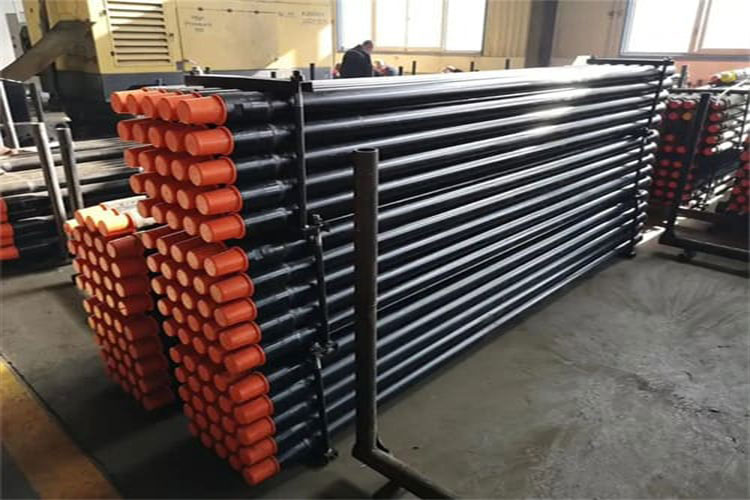
What to Look For: If you have a caliper and can measure your joint OD and it has shrunk more than 7% to 10% from original size you are in the danger zone. A G-105 joint and an S-135 joint of the same nominal size may have different minimum OD specs . Different steel grades have different minimums . If you are unsure, go down a level.
Pro Tip: Apply hardbanding (wear resistant weld overlay) to the joint OD before the rod goes into service. You give yourself to the wall of the borehole Instead of your joint steel. This one practice can literally double or triple the life of your joints.
Wall thinning, the silent killer
This one spooks me. Because you can’t see it by looking.
Every time you pull that rod back you stretch it out. Through thousands of cycles of tension, torque and bending, the steel thins out. Run your hand down the length of the pipe (gloves on please, I’m not trying to get you stitches). Do you feel those little ridges . We call it “spiraling” or “hourglassing.” And if you catch the light right, it looks like fish scales.
A lot of rookies are like, ‘Oh, it’s just surface wear. Nope. That’s the pipe stretching out unevenly. Put a caliper on it and I’ll bet you it’ll be thinner in the middle than the ends.
The number is here: API standard states that if wall thickness reduction exceeds 12.5% of the nominal wall thickness, the pipe must be retired. And this is where it gets interesting. If you reduce the wall thickness by 1mm, you reduce the yield strength of your drill pipe by about 15% to 20%. That’s a lot.
That’s the day you retire it, the day you see that rod is actually 1/16″ thinner than it was. That rod is a time-bomb. and if it breaks it will probably break in the middle and not at the threads And those are the worst fishing jobs you will ever have to do.
Ovality: When Round is No Longer Round
This is the one that no one checks until it breaks down.
Ovality is when your pipe is not round, it is not a circle anymore, it is more like an egg. It is caused by the repeated bending stress, from oversteering or just from the sheer abuse of dragging through difficult ground.
I’ve seen crews run rods that were obviously out of round and they just keep running them downhole. “Stop it.
What the figures reveal: If the ellipticity is > 2mm, it implies plastic deformation and a significant loss of strength. Or, in other words: Ovality in excess of about 2% of the nominal pipe diameter is a red flag.
So what? A pipe that is out of round will not seal properly. It doesn’t transmit torque properly. When under load, the stress is concentrated on the flattened areas, rather than being evenly distributed all the way around. And that’s how you get cracks. That’s how you get failures.”
Quick test: roll the rod on a flat surface. Any wiggle? That’s a bent rod that’s going to fatigue fast. Same for ovality. If it doesn’t roll true, it’s time to measure and make a call.
The last word
Look, I’m not trying to get you to buy more rods than you need to. I’m here to save you from blowing a $50,000 bore, trying to save a $500 rod.
Here’s my rule of thumb:
OD wear down 7-10 % ? Begin shopping.
Wall 12.5% less? Take it off.
2mm ovality? Done.
And if you hear a new, deeper vibration or groan that is not coming from the engine, stop and check your pipe. That sound is metal fibers ripping inside. You can’t grease that, you know.
I’ve been around long enough to know that the most expensive rod you ever buy is the one you don’t replace when you should.
Be safe out there. And if you ever are unsure if a rod is complete, just give me a call. I’d rather explain it to you on the phone than get a call about a broken rod 40 ft down.
By Frank
HDD Engineering Sales
RICHDRILL EQUIPMENT CO.,LTD
Share :
Recently Released
- How to Detect Fake HDD Drill Rods Before They Fail Downhole
- How Stabilizers and Reamers Add Stress to Your HDD Drill Rods (And What You Can Do)
- When to Scrap Your HDD Drill Rods: OD Wear, Wall Thinning and Ovality Limits
- The #1 Mistake New HDD Operators Make With Drill Pipe (And How To Fix It Right Now)
- HDD Projects for River Crossings: How to Select Drill Rods That Won’t Buckle