Let me tell you a story – and maybe save you a very expensive headache.
I’ve been in this industry for about five years now, working with drill rods day in and day out. And if there is one thing I have learned from experience it is this: never, ever buy HDD drill rods without asking for the Mill Test Report first.
I know, I know, paperwork is boring. You lead a busy life. You had crews to manage, jobs to bid, holes to drill. The last thing you want to do is to read through some technical document that looks like it was written in another language. But I trust you on this one. I have seen the consequences of skipping this step and they are not pleasant.
What then is a MTR?
Your drill rod’s MTR (Mill Test Report) is like its birth certificate. This is a quality assurance document which defines the chemical composition, mechanical properties, material grade, heat number and applicable specifications for a particular batch of steel.
Simple English? It tells you exactly what your drill rod is made of not what the sales guy told you it is made of but what the steel mill produced.
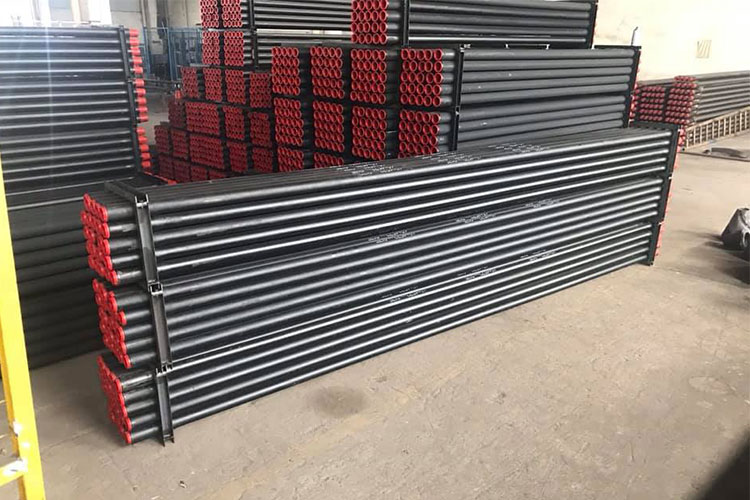
An MTR documents a single heat of steel—one melt, one set of chemistry and mechanical numbers, one mill quality department signature. Every length of pipe rolled out of that heat has the same chemistry. The heat number is the key that links a piece of pipe in your rack to the paper that certifies it. Remove the heat number and the MTR is simply an attractive looking document about some steel, somewhere.
My “Aha” Moment
Can never forget my first year in this business.” A customer called me in a rage. He had bought a batch of “G105” drill rods from a competitor at what seemed like a great price. Four weeks in and the bore snapped two rods. Lost a reamer. Lost a day of production. Lost his crew’s confidence.
I asked him if he’d seen the MTRs before he bought them. “They told me they had them,” he said.
That was all. They said it. He never asked to view them. He never checked to see if the rods were the correct heat number. He just listened to some salesperson, who probably had a script to follow.
That job ended up costing him more in downtime and replacement equipment than he saved in the initial purchase. Worst of all? It was totally preventable.
Why This Matters for HDD, More Than You Think
Horizontal directional drilling is subject to a type of abuse that vertical drilling is not. Your rods are bending and twisting and dragging through soil and rock, touching the wall of the borehole all of your working life. These are subjected to continuous cyclic bending stress from tension to compression.
You can’t make a high performance tool with low-grade materials. Only certified alloy steel of high quality and a MTR can save you from catastrophic material failure.
An MTR documents the pipe’s condition when it left the mill – its heat chemistry, its mechanical properties, the tests it passed and its traceability back to the melt. It proves that a joint of drill pipe is actually the grade that the seller claims it is.
The Trap Buyers Commonly Fall Into
Here’s one that seasoned crews get. The paper in your inbox may actually be a certificate of compliance and not the real test data. A certificate of compliance is a statement that the product conforms to a specification, but does not contain the underlying test data. An MTR, however, has the actual numbers: chemistry analysis, mechanical properties, yield strength, tensile strength, elongation, hardness.
Get the wrong one and you could be signing for pipe on a certificate that proves next to nothing.
What to Look For in a MTR
When you ask for a MTR – and you will, won’t you? — the thing to look for is this:
Heat number matches — check with the stamping on the pipe itself
Chemical composition — C, Mn, P, S, Si, Cr, Mo, Ni
Mechanical properties — yield strength, ultimate tensile strength, elongation, hardness — and make sure they’re within the grade’s allowed range, not just above minimums
Test date – recent – from a certified lab
Grade designation — G105, S135, V150 — make sure it’s what you ordered
Red Flags to Look For
I’ve seen some shady MTRs over the years. Warning signs are:
Suspiciously round numbers (real test results have decimals.)
Missing heat numbers
No lab accreditation stamp”
Mechanical values are exactly minimum values in several heats – this can be a sign of copied or fabricated documents
Fake or altered MTRs – fake documents are a real problem in our industry
If a supplier is hesitant or unable to produce a MTR, treat this as a major red flag. A transparent, quality-conscious partner will be happy to provide them.
The Final Word
Look, I understand. Price is important. Budgets are tight. But here’s the thing: the least expensive drill rod is almost never the least expensive drill rod. Not when you add in downtime, lost productivity, replacement equipment and the damage to your reputation.
Request a MTR, it costs nothing, it could save you everything. It is your guaranty, the only guaranty, that the material is made to the exact specifications required by the tremendous stress of drilling.
So, before you sign that purchase order, do yourself a favor. Ask the MTR. Read it. Check the heat number Make sure you are getting what you paid for.
Your crews – and your bottom line – will appreciate it.
By Frank
HDD Engineering Sales
RICHDRILL EQUIPMENT CO.,LTD
Share :
Recently Released
- How to Detect Fake HDD Drill Rods Before They Fail Downhole
- How Stabilizers and Reamers Add Stress to Your HDD Drill Rods (And What You Can Do)
- When to Scrap Your HDD Drill Rods: OD Wear, Wall Thinning and Ovality Limits
- The #1 Mistake New HDD Operators Make With Drill Pipe (And How To Fix It Right Now)
- HDD Projects for River Crossings: How to Select Drill Rods That Won’t Buckle